

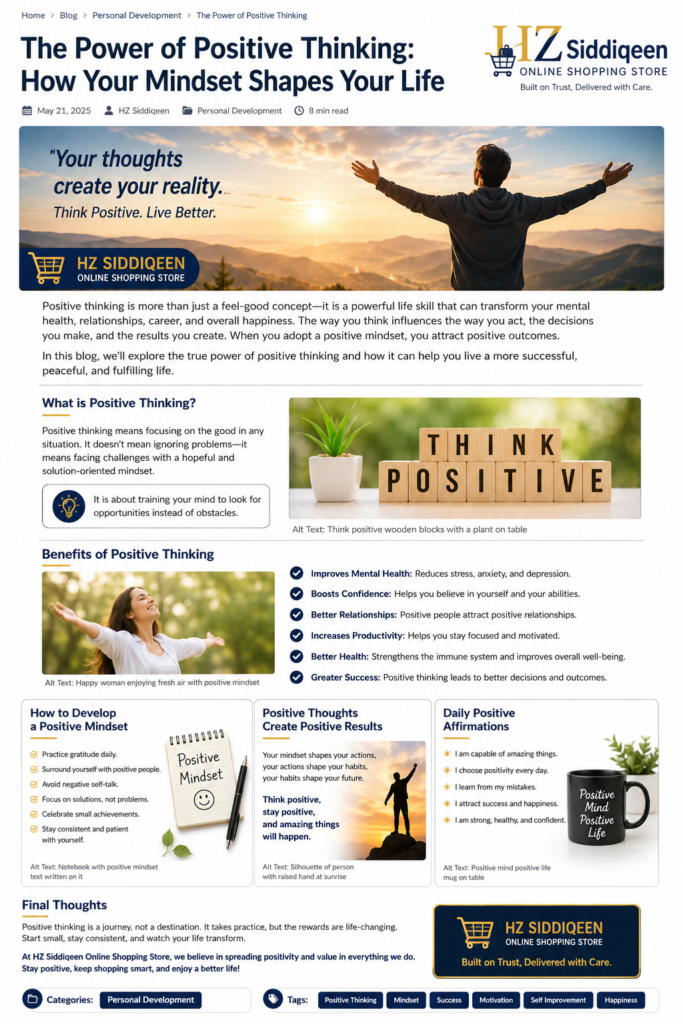
Positive thinking is more than simply telling yourself to “stay positive.” It is a mindset that can influence how you approach challenges, make decisions, build relationships, pursue goals, and respond to everyday situations.
Life is not always easy. Everyone experiences disappointment, failure, stress, uncertainty, and difficult moments. A positive mindset does not mean ignoring these challenges. Instead, it means learning to face them with hope, resilience, patience, and a solution-oriented attitude.
Your thoughts influence your emotions, your emotions influence your actions, and your actions gradually shape your habits and your life.
In this article, let’s explore the power of positive thinking and discover practical ways to develop a healthier and more constructive mindset.
What Is Positive Thinking?

Positive thinking means deliberately focusing on possibilities, solutions, strengths, and opportunities while realistically acknowledging life’s difficulties.
It does not mean pretending that everything is perfect.
For example, instead of thinking:
“I failed, so I can never succeed.”
A positive and realistic mindset might say:
“I didn’t achieve my goal this time, but I can learn from the experience and try again.”
The difference is not in the situation—it is in the way you interpret and respond to it.
How Your Mindset Shapes Your Life

Your mindset can influence many areas of your life.
When you consistently develop constructive ways of thinking, you may become better at:
- Handling everyday challenges
- Learning from mistakes
- Setting meaningful goals
- Maintaining motivation
- Building healthy relationships
- Making thoughtful decisions
- Adapting to change
- Recognizing opportunities
A negative mindset can make problems appear bigger and possibilities smaller. A balanced positive mindset helps you look for practical solutions without denying reality.
Powerful Benefits of Positive Thinking
1. It Helps You Handle Challenges
Difficult situations are unavoidable.
Positive thinking can help you approach challenges with a “What can I do?” attitude instead of immediately assuming that nothing can be done.
This can encourage problem-solving, persistence, and resilience.
2. It Builds Self-Confidence
The way you speak to yourself matters.
Constantly telling yourself that you are incapable can gradually weaken your confidence. Encouraging yourself to learn, improve, and keep trying can help develop greater self-belief.
Instead of:
“I can’t do this.”
Try:
“I may find this difficult, but I can learn.”
3. It Can Improve Relationships
People generally appreciate kindness, encouragement, understanding, and constructive communication.
A positive attitude can help you:
- Listen more carefully
- Appreciate others
- Forgive mistakes
- Communicate respectfully
- Celebrate other people’s achievements
Healthy relationships are built through consistent actions, not simply positive thoughts.
4. It Encourages Productivity
When you believe that your efforts can make a difference, you are more likely to take action.
A positive mindset can help you focus on what you can control rather than spending all your energy worrying about what you cannot change.
5. It Helps You Learn From Failure
Failure can be painful, but it can also provide valuable lessons.
A constructive mindset asks:
“What can I learn from this experience?”
rather than:
“Why does everything go wrong for me?”
This shift can turn setbacks into opportunities for learning and improvement.
6. It Encourages Gratitude
Gratitude helps you recognize the good things already present in your life.
You can practice gratitude by appreciating:
- Family and friends
- Opportunities
- Education
- Work
- Health and well-being
- Small daily moments
- Personal achievements
You don’t need a perfect life to appreciate what is meaningful.
7. It Supports a More Hopeful Outlook
Positive thinking can help you look toward the future with greater hope.
Hope does not guarantee that everything will work out exactly as planned. Instead, it encourages you to believe that your actions can still make a difference.
How to Develop a Positive Mindset
Positive thinking is a skill that can be developed through practice.
Here are some simple habits you can introduce into your daily routine.
1. Start Your Day With Positive Intentions
Instead of immediately focusing on everything that could go wrong, begin your morning by deciding what you want to accomplish.
Ask yourself:
“What is one good thing I can do today?”
It could be something small, such as exercising, completing an important task, helping someone, or learning something new.
2. Practice Gratitude Every Day
Take a few moments each day to identify three things you appreciate.
They don’t have to be extraordinary.
A peaceful morning, a supportive friend, a good meal, a useful opportunity, or simply having another day to learn and grow can all be reasons for gratitude.
3. Replace Negative Self-Talk
Pay attention to the way you talk to yourself.
When you notice an unnecessarily harsh thought, try replacing it with something more balanced.
Negative: “I always make mistakes.”
Balanced: “I made a mistake, and I can learn from it.”
Negative: “I will never succeed.”
Balanced: “Success may take time, but I can keep improving.”
The goal is not unrealistic optimism. The goal is constructive thinking.
4. Surround Yourself With Positive Influences

The people and content around you can influence your mindset.
Spend more time with people who:
- Encourage personal growth
- Respect others
- Offer constructive advice
- Celebrate progress
- Support your goals
Also be mindful of constantly consuming content that increases unnecessary negativity or fear.
5. Focus on Solutions
Problems deserve attention, but constantly thinking about a problem without taking action rarely helps.
When something goes wrong, ask:
- What happened?
- What can I control?
- What can I learn?
- What is my next practical step?
This simple process can turn frustration into action.
6. Celebrate Small Progress
You don’t have to wait for a huge achievement before appreciating yourself.

Celebrate small victories.
Finished an important task?
That’s progress.
Learned something new?
That’s progress.
Handled a difficult situation calmly?
That’s progress.
Small improvements can eventually create significant changes.
7. Be Patient With Yourself
Personal growth takes time.
You may have productive days and difficult days. That doesn’t mean you have failed.
Treat yourself with the same patience and encouragement that you would offer to someone you care about.
Positive Thinking Does Not Mean Ignoring Reality
One important point is often misunderstood.
Positive thinking is not denial.
You don’t need to pretend that problems don’t exist.
If you are facing financial difficulties, relationship problems, career challenges, or other serious issues, simply saying “everything is fine” does not solve them
A healthier approach is:
Recognize the problem → Accept reality → Identify what you can control → Take constructive action.
This is a more practical form of positive thinking.
The Connection Between Thoughts, Habits and Results
Your mindset can influence your behavior.
For example:
Thought → Emotion → Action → Habit → Result
If you repeatedly think:
“I can improve.”
you may be more willing to practice.
More practice can create better skills.
Better skills can create better opportunities.
Better opportunities can eventually produce better results.
This is why developing a constructive mindset can be so valuable.
10 Positive Thoughts to Practice Every Day
You can use these statements as daily reminders:
- I can learn from my mistakes.
- I am capable of improving.
- I will focus on what I can control.
- I don’t need to be perfect to make progress.
- Every day gives me another opportunity to learn.
- I can face challenges one step at a time.
- My mistakes do not define my entire future.
- I will appreciate the good things in my life.
- I can choose how I respond to difficult situations.
- Small progress is still progress.
A Simple 5-Minute Positive Thinking Routine
You don’t need hours of meditation or complicated routines.
Try this simple five-minute practice:
Minute 1: Breathe
Take a few slow, comfortable breaths and allow yourself to settle.
Minute 2: Gratitude
Think of three things you appreciate.
Minute 3: Goal
Choose one important thing you want to accomplish today.
Minute 4: Positive Statement
Tell yourself something realistic and encouraging:
“I can handle today’s challenges one step at a time.”
Minute 5: Action
Identify the first small action you can take toward your goal.
Then begin.
Positive Thinking and Success
Success is rarely created by one big decision.
It is often the result of small decisions repeated consistently.
A positive mindset can encourage you to keep learning after failure, continue working when progress is slow, and recognize opportunities that you might otherwise overlook.
Whether you are building a career, running a business, studying, improving relationships, or simply trying to live a happier life, your attitude can influence the choices you make along the way.
Positive Thinking in Everyday Life
You don’t need to wait for a major life event to practice positive thinking.
Use it during ordinary situations:
At Work
Instead of complaining about every difficulty, identify what can be improved.
In Business
Instead of viewing competition only as a threat, look for ways to improve your products and customer service.
In Education
Instead of fearing difficult subjects, approach them as skills you can gradually learn.
In Relationships
Instead of assuming negative intentions, communicate and seek understanding.
While Shopping
Instead of buying impulsively, make thoughtful choices based on quality, value, and your actual needs.
A positive mindset can become part of everyday decision-making.
Final Thoughts
The power of positive thinking lies not in pretending that life is perfect, but in learning to approach life with hope, resilience, gratitude, and constructive action.



You cannot control every event that happens to you. However, you can often influence how you respond.
Change your thoughts.
Improve your habits.
Take positive action.
Learn from your mistakes.
Celebrate your progress.
And remember: a better life is often built one small positive choice at a time.


At HZ Siddiqeen Online Shopping Store, we believe in creating a positive experience for our customers through quality, convenience, trust, and care.
HZ Siddiqeen – Built on Trust, Delivered with Care.
Stay positive. Shop smart. Live better.